
Quick summary: Affiliate marketing is earning a commission by recommending the right product to the right person with a tracked link. It’s legit, but not instant. Hype is the fastest way to waste money.
If you’re new to affiliate marketing for beginners, you’ll probably see two extremes:
- “It’s easy money, anyone can do it.”
- “It’s saturated and dead.”
Both takes are usually selling something.
Affiliate marketing is a real business model. It can work. But it only works long-term when you’re actually helping people make a better decision — not just chasing clicks.
This guide is for beginners with limited time and budget. You’ll learn what affiliate marketing is, how it works, what you’ll do week to week, and what to avoid so you don’t waste money on hype.
Affiliate disclosure: Some links on ConvertStack may be affiliate links…
Contents
- 1 This is the cleanest definition of affiliate marketing for beginners.
- 2 How affiliate marketing works (the 4-part model)
- 3 What you actually do day-to-day (the real job)
- 4 How people make money with affiliate marketing (realistic scenarios)
- 5 What affiliate marketing is NOT (and what to avoid)
- 6 Affiliate marketing for beginners: the simplest plan (limited time + budget)
- 7 Do you need a course?
- 8 My recommendation if you want a clean next step
- 9 FAQs
- 10 Conclusion: the no-hype summary
This is the cleanest definition of affiliate marketing for beginners.
Affiliate marketing means you recommend a product or service using a tracked link, and you earn a commission if someone buys through your link.
That’s it.
You’re not creating the product. You’re not shipping anything. You’re not handling support. Your job is to match the right offer to the right person and explain why it’s a fit.
If you can do that clearly and honestly, affiliate marketing can be a clean way to monetize content.
How affiliate marketing works (the 4-part model)
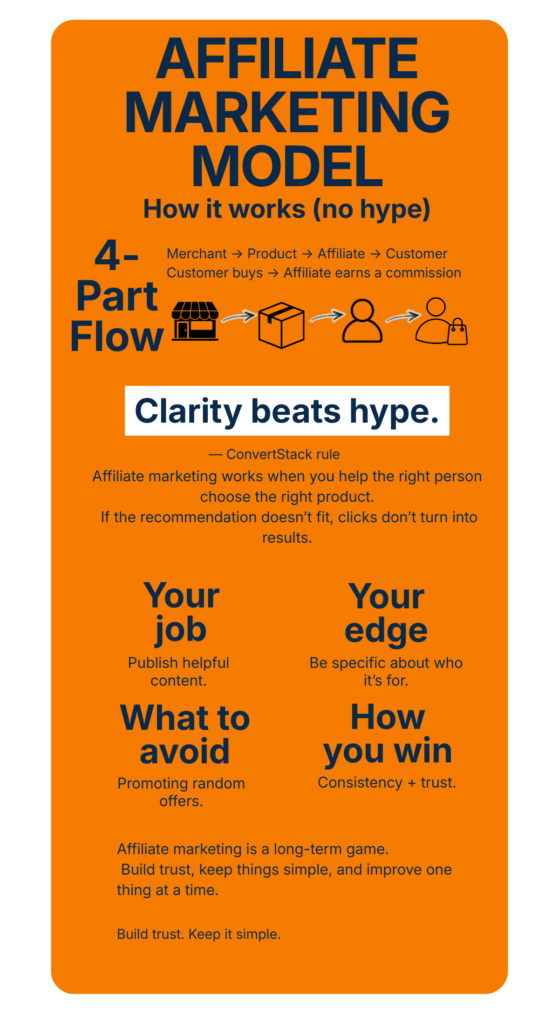
Affiliate marketing has four moving parts. Understanding them makes everything else less confusing.
The 4 pieces
- Merchant (seller): the company or creator selling something
- Product: the course, software, service, or subscription
- Affiliate (you): the person who recommends it
- Customer: the person who buys
The merchant pays affiliates because affiliates can bring customers the merchant wouldn’t have reached otherwise.
Where the tracking happens
Affiliate links contain tracking information. When someone clicks your link, the seller can attribute a purchase to you.
You don’t need to understand the technical details to start. Just remember this:
If your recommendation isn’t useful, you may get clicks… but you won’t get consistent conversions, and you won’t build trust.
What you actually do day-to-day (the real job)
Affiliate marketing is not “posting links.” That’s the beginner trap.
The real job is publishing content that answers questions people already have, then recommending the best next step.
Here are the most common paths.
The content path (best long-term)
This is the most predictable path if you’re building a site like ConvertStack.
You publish pages like:
- “Best ___ for beginners”
- “___ review: who it’s for / not for”
- “___ vs ___”
- “How to choose ___”
It can feel slow at first. But the upside is huge: you’re building assets that can keep getting traffic over time.
The email path (most control)
Email is powerful because you control the relationship. You’re not fully dependent on Google, YouTube, or social algorithms.
The simple version:
- offer something useful (checklist, starter pack, short guide)
- build a list
- send helpful emails consistently
- recommend products when it genuinely makes sense
Email isn’t “spam people until they buy.” It’s “stay helpful until they’re ready.”
Social can bring attention quickly, but it’s usually less stable long-term.
If you use social, the best move is to use it as a feeder:
- social → website content and/or email list
That way you keep the audience you earn.
How people make money with affiliate marketing (realistic scenarios)
Most beginners expect instant results. Realistically, affiliate marketing usually happens in phases:
- First sales happen when you publish content that matches a high-intent question.
- Consistent sales happen when you have multiple pages that attract the right people every week.
Here’s what matters most:
- Traffic: people have to find your content
- Trust: they have to believe you’re not wasting their money
- Offer fit: the recommendation must match their situation
If any of those three are missing, income becomes random.
This is why ConvertStack focuses on rankings and honest reviews. The goal isn’t to convince people to buy. The goal is to help them buy the right thing (or avoid the wrong thing).
What affiliate marketing is NOT (and what to avoid)
This section will save you the most time and money.
Red flags to treat as a warning sign
Be skeptical of anything that claims:
- guaranteed income
- “copy/paste system”
- “make money while you sleep” as the main pitch
- “no work required”
- secret loopholes or hacks
- heavy pressure tactics (“limited spots” with no real reason)
Affiliate marketing is simple, but it’s not magic. If the pitch is bigger than the plan, walk away.
Why most beginners waste money
In my experience reviewing courses and online offers, beginners usually get stuck for predictable reasons:
- they keep buying training instead of publishing
- they jump niches constantly
- they promote random offers without understanding who they’re for
- they chase shortcuts instead of fundamentals
- they copy tactics without learning the why
The fix is boring, but it works: pick one direction and keep going long enough to get feedback.
Affiliate marketing for beginners: the simplest plan (limited time + budget)
Save this: it’s the simplest plan that works long-term.
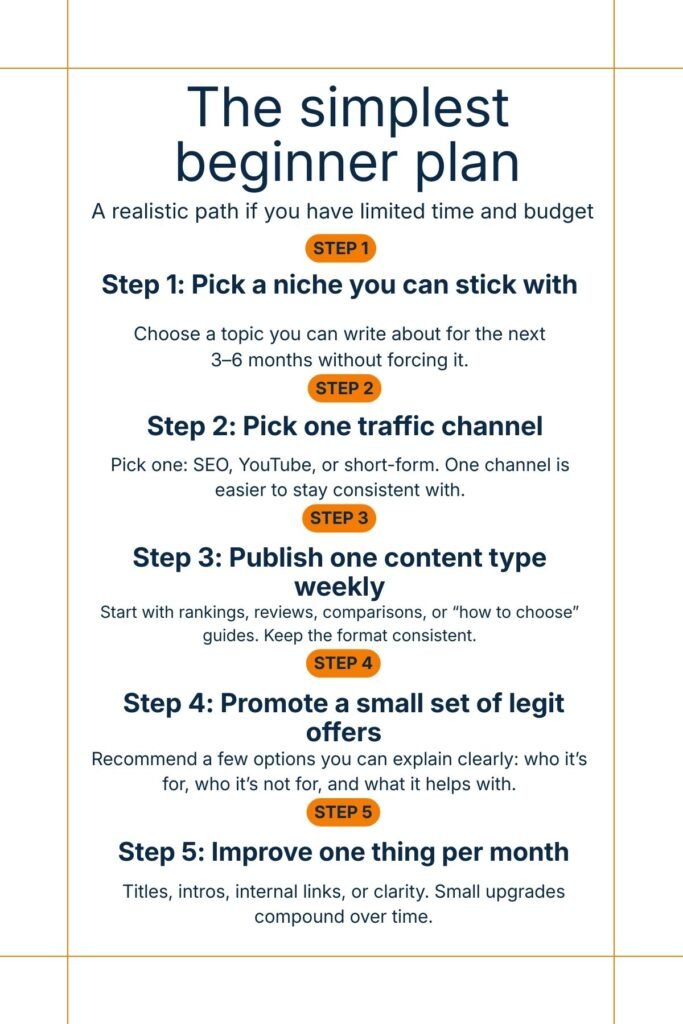
If you want a plan that doesn’t require a big budget, start here.
Step 1 — Pick a niche you can stick with
Your niche doesn’t need to be “perfect.” It needs to be stable enough that you can create helpful content for months without forcing it.
A simple test:
If you can’t imagine writing 20 helpful posts about it, it’s probably not the right niche for you.
Step 2 — Pick one traffic channel
Don’t try to do everything at once. Pick one.
- SEO (Google)
- YouTube
- Short-form social
- Email partnerships
If you’re building ConvertStack as a blog, SEO is a natural fit because the content can compound over time.
Step 3 — Pick one content type to publish consistently
The easiest content types for affiliate marketing are:
- Rankings: best options for a specific scenario
- Reviews: a single course explained clearly
- Comparisons: course A vs course B
- Buyer guides: how to choose without wasting money
Pick one type and publish on a predictable schedule you can actually maintain.
Step 4 — Promote a small set of legit offers
Most beginners do the opposite: they promote a lot of offers badly.
Start small.
Choose a handful of offers that match your audience and that you can explain honestly.
If you can’t clearly describe:
- who it’s for
- who it’s not for
- what it helps with
- what it doesn’t do
…you shouldn’t promote it yet.
Step 5 — Improve one thing per month
Affiliate marketing improves through iteration.
Each month, pick one focus:
- clearer titles
- better “who it’s for” sections
- stronger comparisons
- better internal linking
- stronger intros and conclusions
- cleaner calls to action (without pressure)
Small improvements compound.
Do you need a course?
Sometimes yes. Sometimes it’s a waste.
A course is worth it if…
- you want a structured roadmap instead of piecing things together randomly
- you’re overwhelmed and need a clear sequence
- you’ll follow one plan long enough to get results
- you want examples and templates that save time
A good course doesn’t make affiliate marketing “easy.” It makes it less confusing.
Skip the course if…
- you haven’t published anything yet
- you’re hoping the course will “motivate” you
- you’re still switching niches every week
- you’re buying courses to avoid doing the work
If you don’t have time to publish, a course won’t fix that. It will just become another tab you never finish.
My recommendation if you want a clean next step
If your goal is to build something real (without hype), do this:
- Learn the basics (you’re doing that now)
- Pick a niche and publish consistently
- Use a course only if it helps you follow a clear roadmap
Next, I’m publishing a ranked list of beginner-friendly affiliate marketing courses — with a strong focus on who each option is for, and who it’s not for.
Next: Best Affiliate Marketing Courses for Beginners (Ranked) (publishing next)
FAQs
Yes. It’s a real referral model used by companies across industries. The sketchy part is usually the marketing around it, not the model itself.
Usually per sale. Some programs pay per lead or trial signup. The payout rules depend on the merchant.
Not strictly, but a website is the most reliable long-term asset if you want SEO traffic and content that compounds.
It depends on your traffic source and consistency. Anyone promising a specific timeline is guessing. Focus on publishing and improving instead
Some topics are crowded, but clear angles still work. “Best for beginners,” “best for budget,” and “who it’s not for” are examples of angles that help you stand out.
A niche you can stick with and create helpful content for. Consistency beats “perfect niche” research.
It varies widely. There’s no honest guarantee. Your best lever is building trust with useful content and promoting offers that match the reader.
Buying too many courses and publishing too little. Progress comes from creating and iterating.
Sometimes. Offer quality varies, so you have to be selective. Promote only what you can recommend confidently.
Not always, but you must be honest about what you verified. Never imply hands-on experience if you don’t have it.
Conclusion: the no-hype summary
For affiliate marketing for beginners, the fastest progress comes from publishing consistently and staying honest about fit.
What makes it hard isn’t the model — it’s the noise. Ignore the hype, focus on clarity, and build trust one post at a time.
If you want a structured next step, the next article will help you choose a course without wasting money.
Next (coming soon): Best Affiliate Marketing Courses for Beginners (Ranked)